Tuesday, October 30, 2012

And I, cut off from the world, remain... Alone with the terrible hurricane.


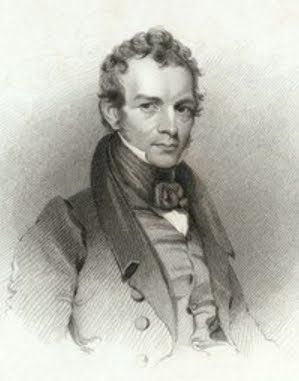
William Cullen Bryant is considered one of the most accomplished and popular American poets of the first half of the 19th century.  He was an early proponent of Romanticism in American literature and his work is often compared to English Romantic, William Wordsworth.
    

The Hurricane
by William Cullen Bryant (1854)

            Lord of the winds! I feel thee nigh,
I know thy breath in the burning sky!
And I wait, with a thrill in every vein,
For the coming of the hurricane!
 
            And lo! On the wing of the heavy gales,
Through the boundless arch of heaven he sails;
Silent and slow, and terribly strong,
The mighty shadow is borne along,
Like the dark eternity to come;
While the world below, dismayed and dumb,
Through the calm of the thick atmosphere
Looks up at its gloomy folds with fear.
 
            They darken fast; and the golden blaze
Of the sun is quenched in the lurid haze,
And he sends through the shade a funeral ray—
A glare that is neither light nor day,
A beam that touches, with hues of death,
The clouds above and the earth beneath.
To its covert glides the silent bird.
While the hurricane’s distant voice is heard,
Uplifted among the mountains round,
And the forests hear and answer the sound.
 
            He is come! He is come! Do ye not behold
His ample robes on the wind unrolled?
Giant of air! we bid thee hail!—
How his gray skirts toss in the whirling gale;
How his huge and writhing arms are bent,
To clasp the zone of firmament,
And fold at length, in their dark embrace,
From mountain to mountain the visible space.
 
            Darker- still darker! The whirlwinds bear
The dust of the plains to the middle air;
And hark to the crashing, long and loud,
Of the chariot of God in the thunder-cloud!
You may trace its path by the flashes that start
From the rapid wheels where’er they dart,
As the fire-bolts leap to the world below,
And flood the skies with a lurid glow.
 
            What roar is that?—‘tis the rain that breaks
In torrents away from the airy lakes,
Heavily poured on the shuddering ground,
And shedding a nameless horror round.
Ah! well known woods, and mountains, and skies,
With the very clouds!—ye are lost to my eyes.
I seek ye vainly, and see in your place
The shadowy tempest that sweeps through space,
A whirling ocean that fills the wall
Of the crystal heaven, and buries all.
And I, cut off from the world, remain
Alone with the terrible hurricane.

Saturday, October 27, 2012

Legend of Halloween.... a usurped Samhain?


The origins of Halloween come from the Celtic “Festival of the Dead” called Samhain (pronounced Sah-ween). This is the biggest and most significant holiday on the Celtic calendar and marks the New Year and the beginning of winter.

Celts believed that at the time of Samhain, more so than any other time of the year, ghosts of the dead were able to mingle with the living; because the souls of those who died during the year traveled into the otherworld during Samhain.

In much of the Gaelic world, bonfires were lit and people would often walk with their livestock between two bonfires as a cleansing ritual… bones of slaughter livestock were cast into its flames.  Feasts were had, at which the souls of dead kin were beckoned to attend and a place at the table was set for them.

People also took steps to protect themselves from harmful spirits, which is thought to have led to the custom of guising.  It is said that the sidhe, fairy mounds and portals to the fairy world, were always open at Samhain.  Fairies were often thought to steal humans on this holiday and people took steps to ward-off these harmful spirits and fairies.  Fairy mounds were avoided, people stayed close to home and if forced to walk in darkness, they turned their clothing inside-out and carried iron or salt to keep the fairies at bay.  Offerings of food were left at the door for the fairies to ensure favor in the coming year.

Turnip lanterns, sometimes with faces carved into them, were common.  Their purpose is said to be threefold:  they were used to light one’s way while outside on Samhain night; to represent the spirits and otherworldly beings; and to protect one’s home from them.

Divination was also performed at Samhain.  The most common uses were to find out the identity of one’s future spouse, the location of one’s future home and how many children one might have.  Season foods, like apples and nuts, were eaten during these rituals.  Apple peels were used to divine the first letter of the future spouse’s name, nuts were roasted to predict if a couple would stay together and egg whites were used to tell how many children someone might have.  Children would also chase crows and divine some of these things from the number of birds or the direction they flew.

Christians, in an attempt to convert “natives”, effectively and majorly transformed the holiday.  In 601 AD, Pope Gregory the First issued the famous edict to his missionaries; if group of people worshiped a tree, rather than cut it down, he advised them to consecrate it to Christ and allow its continued worship.

While the method of converting holidays to facilitate conversion was effective, Celtic belief in supernatural creatures persisted.  To offset this, the church made these creatures not only dangerous, but malicious and followers of the old religion were branded as witches.

Through time, the old beliefs never died out completely.  All Hallows Eve is still a time of the wandering dead, but the supernatural beings are now all thought to be evil.

It is still common for children and adults alike to dress like these dreadful creatures; performing antics in exchange for food and drink.  To this day, witches, ghosts and skeletons remain among favorite holiday disguises.

Trick-or-Treat!

Baudelaire's THE ALBATROSS.... the Poet versus Himself


Charles Baudelaire’s The Albatross, is a stirring description of his own feelings on being a man and a poet.

Baudelaire compares "the poet" to an Albatross: for as beautifully graceful as the majestic bird is in flight, it is equally as awkward and ridiculed while on the ground; as is the Poet-  who reaches into the mystical heavens to touch life itself- only to feel ugly, ridiculed and misunderstood by those around him.


The Albatross
by Charles Baudelaire (translated William Aggeler 1954)

Often, to amuse themselves, the men of a crew
Catch albatrosses, those vast sea birds
That indolently follow a ship
As it glides over the deep briny sea.

Scarcely have they placed them on the deck
Than these kings of the sky, clumsy, ashamed,
Pathetically let their great white wings
Drag beside them like oars.

That winged voyager, how weak and gauche he is,
So beautiful before, now comic and ugly!
One man worries his beak with a stubby clay pipe;
Another limps, mimics the cripple who once flew!

The poet resembles this prince of cloud and sky
Who frequents the tempest and laughs at the bowman;
When exiled on the earth, the butt of hoots and jeers,
His giant wings prevent him from walking.

Baudelaire is credited with coining the term, “modernity” to designate the changing nature of beauty in modern, industrializing Paris during the 19th century.  His most famous work, Les Fleurs du mal (The Flowers of Evil) was first published in 1857.

Wednesday, October 24, 2012

Wordsworth’s "Lucy Gray, or Solitude"… Evolution of Body to Spirit


Lucy GrayOne of Wordsworth’s most haunting ballads of childhood, Lucy Gray, or Solitude describes the death of a young girl who went out one evening into a storm and was never found again.

Written while Wordsworth was in Goslar, Germany, it was founded on a true circumstance told to him by his sister, Dorothy, of a little girl who was bewildered in a snow-storm. Her footsteps were traced by her parents to the middle of the lock of a canal, and no other vestige of her could be traced.  Her body was later found in the canal.

Noteworthy in this poem is Wordsworth’s use of the bridge.  Lucy’s parents follow her footsteps to the middle of the bridge (a connection of two sides) and then they disappear.  The fact that she disappears in the center of two opposing sides poetically launches Lucy into another realm of existence altogether.

Lucy becomes the symbol of the interface between life/death, body/spirit, this life/the next, realism/imagination, civilization/nature (an interplay of opposites reminiscent of 17th century poet, John Donne).

Wordsworth’s description of Lucy’s spirit singing a solitary song “That whistles in the wind” connects her to nature and makes her evolve out of and pass back into the landscape; just as she passes in and out of this world and the next.

Lucy Gray, or Solitude by William Wordsworth

Oft I had heard of Lucy Gray,
And when I cross’d the Wild,
I chanc’d to see at break of day
The solitary Child.

No Mate, no comrade Lucy knew;
She dwelt on a wild Moor,
The sweetest Thing that ever grew
Beside a human door!

You yet may spy the Fawn at play,
The Hare upon the Green;
But the sweet face of Lucy Gray
Will never more be seen.

“To-night will be a stormy night,
You to the Town must go,
And take a lantern, Child, to light
Your Mother thro’ the snow.”

“That, Father! will I gladly do;
‘Tis scarcely afternoon—
The Minster-clock has just struck two,
And yonder is the Moon.”

At this the Father rais’d his hook
And snapp’d a faggot-band;
He plied his work, and Lucy took
The lantern in her hand.

Not blither is the mountain roe,
With many a wanton stroke
Her feet disperse, the powd’ry snow
That rises up like smoke.

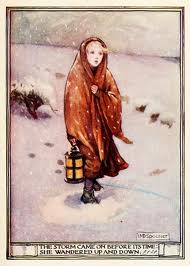
The storm came on before its time,
She wander’d up and down,
And many a hill did Lucy climb
But never reach’d the Town.

The wretched Parents all that night
Went shouting far and wide;
But there was neither sound nor sight
To serve them for a guide.

At day-break on a hill they stood
That overlook’d the Moor;
And thence they saw the Bridge of Wood
A furlong from their door.

And now they homeward turn’d, and cry’d
“In Heaven we all shall meet!”
When in the snow the Mother spied
The print of Lucy’s feet.

Then downward from the steep hill’s edge
They track’d the footmarks small;
And through the broken hawthorn-hedge,
And by the long stone-wall;

And then an open field they cross’d,
The marks were still the same;
They track’d them on, nor ever lost,
And to the Bridge they came.

They follow’d from the snowy bank
The footmarks, one by one,
Into the middle of the plank,
And further there were none.

Yet some maintain that to this day
She is a living Child,
That you may see sweet Lucy Gray
Upon the lonesome Wild.

O’er rough and smooth she trips along,
And never looks behind;
And sings a solitary song
That whistles in the wind.


While Lucy Gray, or Solitude was written in 1789 and published in Lyrical Ballads, it is not one of Wordsworth’s “Lucy” poems.  It is excluded from the series because the traditional “Lucy” poems are uncertain about the age of Lucy and her actual relationship with the poet; Lucy Gray provides exact details on both.

As a contrast to “She dwelt among the untrodden ways” Lucy Gray is not idealized in death through the Romantic notion of love; her loss is quiet obvious in the poem to those who loved her.  Rather, Wordsworth uses this poem to provide an “escape of spirit” for a lost child through the interplay of realism and imagination.

Tuesday, October 23, 2012

The Coming of the Tuatha dé Danann and The Myth of THE HARP OF THE DAGDA


It is said that when the fairy race of the Tuatha dé Danann, children of the goddess Danu, arrived in Ireland they came like a mist across the waters- bringing with them magical gifts. 

The first generation of the Tuatha dé Danann had to fight off the giant races of the Firbolgs and the Formorians. Formorians  The Formorians were a semi-divine race said to have inhabited Ireland in the ancient times. It is believed that they are the beings who preceded the gods, similar to the Greek Titans; having the body of a man and the head of a goat (according to 11th century text), or to have had one eye, one arm and one leg.

The Tuatha dé Danann’s chief of the gods, the Dagda, (father figure and protector of the tribe) was known to have a cauldron (which was said to restore life) and a harp- battle scarred and made of oak.

When his men went to battle, the Dagda would set up his magic harp and sweep his hand across the strings.  A war song would ring out making his warriors buckle his armor; brace his knees and shout, “Forth the fight!” When the men returned, weary and wounded, the Dagda would take his harp and strike a few chords- as the magic music stole out upon the air, every man forgot his weariness and his wounds and thought of the honor he won, and the comrade who had died beside him and the safety of his wife and children.


So it was that after the second battle of Mag Tuiread (Moytura), the Dagda discovered that his harp, together with his harper, had been captured by the Formorians and taken with them in their flight.  Angered beyond measure, he set out with his son to reclaim it.

Stealthily they approached the Formorian camp.  Soon they could hear the sounds of the feasting hall in which Bres, the Formorian king, was dining.  Approaching the doorway, they could just make out through the smoke and candle-flame the outline of the old harp hanging on the wall.  Dagda entered boldly and summoned his harp with this chant:

 Come Daurdable, apple-sweet murmurer
Come, Coir-cethair-chuir, four-angled frame of harmony,
Come summer, come winter
Out of the mouths of harps and bags and pipes!

Immediately the old harp flew to his hand across the hall, killing nine men as it came.  A shocked hush fell on the company.  In the silence, Dagda laid his hands on the strings and unleashed the Three Noble Strains of Ireland that he had bound into his harp.  First he played the goltrai, or strain of weeping, so that all present began to mourn and lament their defeat.  Then he played the geantrai, the strain of merriment, so that the company turned to laughter and drunken foolery.  Lastly he played the suantrai, or sleep-strain, whereupon the warriors fell into a profound slumber.  After this the Dagda and his son left the camp as quietly as they had come, taking the harp and harpist with them.


The Tuatha dé Danann were the children of the great goddess Danu and are depicted as magical fairy people who were later overrun by the Milesians who allowed them to reside underground in the sidhe, or fairy mounds.  In folk belief the sidhe are often appeased with offerings and care is taken to avoid angering or insulting them.  Often they are not named directly, but spoken of as “The Good Neighbors”, “The Fair Folk”, or simply, “The Folk”.  They are generally described as stunningly beautiful, but can also be terrible and hideous.

Monday, October 22, 2012

William Blake's TO AUTUMN- Summer's full-bodied Offspring


Autumn- Summer's full-bodied OffspringWilliam Blake’s To Autumn recounts the meeting of the poet and “Autumn”- the offspring of an inebriated Summer.

Autumn is described by the poet as being “stain’d with the blood of the grape”, a reference to wine (the result of grapes reaching full maturity, death and fermentation) and also a reference to being newborn.  The poet asks Autumn to rest and recount the lusty tale of his creation.

Autumn sings of  the rapture of  Summer (his Mother) and her consummation to the poet's music, “The narrow bud opens her beauties to the sun and love runs in her thrilling veins”.... "Blossoms hand round the brows of morning, and flourish down the bright cheek of modest eve".

Though Autumn is newborn, his time is fleeting.  Sadly, at the poem’s end, the full bodied offspring of Summer is forced to “gird himself” for the coming Winter and fleas from the poet’s sight “o’er the bleak hills”- leaving only his legacy, his “golden load” behind.

To Autumn, by William Blake

Oh Autumn, laden with fruit, and stain’d
With the blood of the grape, pass not, but sit
Beneath my shady roof; there thou may’st rest,
And tune thy jolly voice to my fresh pipe,
And all the daughters of the year shall dance!
Sing now the lusty song of fruits and flowers.

“The narrow bud opens her beauties to
The sun, and love runs in her thrilling veins;
Blossoms hand round the brows of Morning, and
Flourish down the bright cheek of modest Eve,
Till clust’ring Summer breaks forth into singing,
And feather’d clouds strew flowers round her head.

“The spirits of the air live in the smells
Of fruit; and Joy, with pinions light, roves round
The gardens, or sits singing in the trees.”
Then rose, girded himself, and o’er the bleak
Hills fled from our sight; but left his golden load.

To Autumn, an early poem by William Blake and part of a larger work, Poetical Sketches, was published around 1782.

Friday, October 19, 2012

DID YOU KNOW?


Edgar Allan Poe, at the age of 26, married his 13 year old cousin.  Twelve years later, (2 years after publishing "The Raven") she died of TB.

Two years following her death, Poe also died (at age 40); cause of death unknown- but attributed to: alcohol, brain congestion, cholera, drugs, heart disease, rabies, suicide, TB and other agents.

Edgar Allan Poe’s "A Dream"…. lost memories a dark sun


Young Edgar Allan Poe
A Rare Portrait of Young Edgar Allan
"A Dream", one of Edgar Allan Poe’s first poems (written in 1827), is rife with longing and sentiment for memories trapped forever in the past.

The poet’s dreams or “visions of the dark night” are more real…. more bright, than the waking light of day.  These “holy dreams” become his sun; even as the outside world tells otherwise.

This early work by Poe is part of a larger series inspired by the Romantic poet, Lord Byron, and includes the long title poem “Tamerlane”, which depicts an historical conqueror who laments the loss of his first romance.  Tamerlane and Other Poems includes themes of love, death and pride.

Poe’s "A Dream" captures a yearning to hold onto a lost past... a  lost love.... lost joy... lost inspiration; so much so, the poet's truth becomes his dreams.

A Dream, by Edgar Allan Poe

In visions of the dark night
I have dreamed of joy departed-
But a waking dream of life and light
Hath left me broken-hearted,

Ah! what is not a dream by day
To him whose eyes are cast
On things around him with a ray
Turned back upon the past?-

That holy dream- that holy dream,
While all the world were chiding,
Hath cheered me as a lovely beam
A lonely spirit guiding

What though that light, thro’ storm and night,
So trembled from afar-
What could there be more purely bright
In Truth’s day-star?

Thursday, October 18, 2012

The Rooster of Barcelos: A Symbol of Honesty, Faith, Fairness and Luck

The Rooster of BarcelasThe best known legend of Portugal is “The Rooster of Barcelos”.  This is an ancient tale spans as far back as the 13th century and tells the story of a pilgrim accused of stealing silver and sentenced to death.
According to the tale, the inhabitants of Barcelos were very upset about a terrible crime that had gone unsolved.  As alarm was growing, a pilgrim on his way to fulfill a promise had the bad fortune to pass through the city.
Being a stranger, suspicion immediately fell on him, even though he swore his innocence.  He was accused of the crime and condemned to be hung.
As he was being led to the gallows, he made a last request to be taken into the presence of the judge who condemned him.  His request was granted and he was brought to the magistrate’s residence during a dinner party.
The pilgrim swore his innocence before the unbelieving eyes of the judge and his guests.  Unexpectedly, the pilgrim pointed to the roasted rooster on the table and said, “I tell you now that as proof of my innocence, this cock will crow at the hour of my hanging.”
His proclamation was met with laughter and mocking comments.  Nonetheless, no one at the party dared to touch the rooster.
As the sentence was being carried out, the roasted rooster stood up on the table and crowed.  No one doubted the innocence of the condemned man and he was freed, just as the cord was tightening around his neck.
As legend goes, some years later, the pilgrim returned to Barcelos to sculpt the Calvary (or Crucifix) to the Lord of the Rooster (Portuguese, "Cruzeiro do Senhor do Galo") in praise to the Virgin Mary and to Saint James. The monument is located in the Archeological Museum of Barcelos.
For centuries, this tale has stood for Honesty, Faith, Fairness and Luck.
  • Honesty because the pilgrim was innocent; he did not steal and expressed this truthfully.  This honesty was eventually rewarded by a miracle that saved his life.
  • Faith in the power of God; if it weren’t for the pilgrims pious faith, the story may have had a different ending for him
  • Fairness and refrain from believing unproven accusations and unjust snap judgments of our fellow-man.
  • Luck because it was a rooster that saved the pilgrim’s life.
Today this symbol is still regarded as Good Luck around the world.

Wednesday, October 17, 2012

Did You Know?


As late as the Early Twentieth Century, a sprig of mistletoe was believed to bring dreams of a future husband when placed under the pillow of a hopeful young woman

Virgil's THE GOLDEN BOUGH.... Sibyl, Aeneas and Mistletoe??


The Golden Bough, written in the epic Aeneid, book VI, by the Roman poet Virgil (70 – 19 BC), narrates the adventures of the Trojan hero Aeneas after the Trojan War.

Aeneas finds the Golden BoughIn this tale the sibyl (prophetess) Deiphobe, over seven hundred years old, consents to escort Aeneas on a journey into the underworld to comply with his wish to see the “shade” of his deceased father.

Before entering Hades, she tells Aeneas that he must obtain the bough of gold which grows nearby in the woods around her cave; it must be given as a gift to Proserpina (the queen of the Underworld) in order to gain entrance into Hades.

In the woods, Aeneas’s mother, Venus, sends two doves to aid him in this difficult task.  With the assistance from his mother’s doves, Aeneas finds the tree holding the Golden Bough.  When Aeneas tears off the bough, a second golden one immediately springs up, which is a good omen, as the sibyl had said that if this did not happen the coming endeavor would fail.

Aeneas, the Sibyl and Charon
Aeneas, the Sibyl and Charon- by Guiseppe Maria Crispi
Soon after they start their descent into the Underworld, the sibyl shows the golden bough to the ferryman (Charon) who only then allows them to enter his boat and cross the Stygian river.  On the other side, she casts a drugged cake to the three-headed watchdog, Cerberus, who swallows it and falls asleep.
Once in the Underworld, Aeneas puts the golden bough on the arched door of Pluto’s palace (the Ruler of the Underworld) and goes through to the Elysian Fields, the abode of those who led just and useful lives.

Aeneas finally locates his father in the green and sunny Elysium and attempts three times to hug him, but has no success as his father’s shade is like thin air, or empty dreams.

In spite of this, they have a happy encounter and Anchises (father of Aeneas) tells his son a about the nearby river Lethe, the river of forgetfulness, on the other side of which are a multitude of spirits waiting to be born on Earth- many of whom would live in the future Roman Empire such as Romulus, Camillus, Fabillus and Caesars. The Ivory gate, one of the gates of “Sleep” returns the party to Earth.

The Golden Bough was written during the Golden Age of the Roman Empire under the auspices of Caesar Augustis.   Some believe the symbol of “The Golden Bough” refers to mistletoe; as popular superstition cast a mystic glamour on the plant that “blazed into supernatural golden glory”.

It has been believed throughout history that a tree hosting a mistletoe plant was a tree marked as particularly sacred by the gods; its golden color associated with the sun.  It has also been widely believed that mistletoe takes on the properties of its host tree (it actually feeds on its host) containing its essence and power.

Mistletoe has been considered sacred for centuries.  It was a Scandinavian custom that if enemies met under a mistletoe bearing oak tree, they would lay down their arms until morning.  Druids cut mistletoe following the winter solstice and distributed it among the people to hang over their doors for protection against evil in the coming year.

Today, we still hang this mysterious "Golden Bough" from our doorways, as Aeneas and the Sibyl did when entering the gates of Hades, to protect us, and provide good luck in the coming year.

Monday, October 15, 2012

Visit Old Wethersfield Books

Visit Old Wethersfield Books Today!!!!

THE EXTASIE- A Transcendence from Two to One


John Donne is one of the great Metaphysical poets of the 17th century; a period of poetry marked by abrupt and dramatic openings, familiar speech, an argumentative structure and an introspective quality.

Much of Donne’s poetry utilizes the interface of opposites (up/down, physical/spiritual, this/that).  This juxtaposition of disparate concepts creates a window into Supernatural or Metaphysical realm.  Later in the 19th Century, William Wordsworth has this revelation that he refers to as “Spots of Time”.

The Extasie, by John Donne, describes lovers bound together in an embrace that joins two hands…. two bodies….. two souls.  This embrace takes the lovers from a physical union to a spiritual one; resulting in the creation of a third soul that transcends the sum of the two.

The Extasie, by John Donne

Where, like a pillow on a bed
A pregnant bank swell'd up to rest
The violet's reclining head,
Sat we two, one another's best.
Our hands were firmly cemented
With a fast balm, which thence did spring;
Our eye-beams twisted, and did thread
Our eyes upon one double string;
So to'intergraft our hands, as yet
Was all the means to make us one,
And pictures in our eyes to get
Was all our propagation.
As 'twixt two equal armies fate
Suspends uncertain victory,
Our souls (which to advance their state
Were gone out) hung 'twixt her and me.
And whilst our souls negotiate there,
We like sepulchral statues lay;
All day, the same our postures were,
And we said nothing, all the day.
If any, so by love refin'd
That he soul's language understood,
And by good love were grown all mind,
Within convenient distance stood,
He (though he knew not which soul spake,
Because both meant, both spake the same)
Might thence a new concoction take
And part far purer than he came.
This ecstasy doth unperplex,
We said, and tell us what we love;
We see by this it was not sex,
We see we saw not what did move;
But as all several souls contain
Mixture of things, they know not what,
Love these mix'd souls doth mix again
And makes both one, each this and that.
A single violet transplant,
The strength, the colour, and the size,
(All which before was poor and scant)
Redoubles still, and multiplies.
When love with one another so
Interinanimates two souls,
That abler soul, which thence doth flow,
Defects of loneliness controls.
We then, who are this new soul, know
Of what we are compos'd and made,
For th' atomies of which we grow
Are souls, whom no change can invade.
But oh alas, so long, so far,
Our bodies why do we forbear?
They'are ours, though they'are not we; we are
The intelligences, they the spheres.
We owe them thanks, because they thus
Did us, to us, at first convey,
Yielded their senses' force to us,
Nor are dross to us, but allay.
On man heaven's influence works not so,
But that it first imprints the air;
So soul into the soul may flow,
Though it to body first repair.
As our blood labors to beget
Spirits, as like souls as it can,
Because such fingers need to knit
That subtle knot which makes us man,
So must pure lovers' souls descend
T' affections, and to faculties,
Which sense may reach and apprehend,
Else a great prince in prison lies.
To'our bodies turn we then, that so
Weak men on love reveal'd may look;
Love's mysteries in souls do grow,
But yet the body is his book.
And if some lover, such as we,
Have heard this dialogue of one,
Let him still mark us, he shall see
Small change, when we'are to bodies gone.


DID YOU KNOW? Donne was born into a Roman Catholic family in 1572, when practice of that religion was outlawed in England. When he was 21 years old, his brother Henry was arrested for harbouring a Catholic priest, William Harrington, whom Henry betrayed under torture.  Harrington was tortured on the rack, hanged until not quite dead, then was subjected to disembowelment.  Henry Donne died in Newgate prison of bubonic plague.  This series of events lead to John Donne’s questioning of his Catholic faith and eventual conversion to the Anglican religion.


Sunday, October 14, 2012

The General in his Labyrinth: a Commentary on the Maze of Life


The General in his LabyrinthGabriel Garcia Marquez’s novel, The General in his Labyrinth is a moving tale of a man, an exile, a General who makes the slow journey into his past en route to a future he never actualizes.

 The General, whose labyrinth exists in the complexity of his mind and memories, as well as in his fading, consumptive body relives past victories, defeats and passionate love along the road to his eventual death.

There are many manifestations of the Labyrinth throughout the novel, but the most moving is the puzzle he must complete of his own life, in entirety, before he moves on to that quiet and forever sleep.  The General is faced with reconciling his past with his present before making his transition into a future he has difficulty accepting… the end of the road.

The wilderness in his mind and the wanderings of his party into his past recall the joy and pain of a great man, “A Liberator”, “A General” who is both reviled and respected by his people. His mind, lost in the throws of illness and haunted by his memories, suffers greatly; especially during the quiet of the evening when his thoughts gain the most speed.

The slow journey into death, and the quiet resolution the comes with letting go create a truly beautiful character and one that provides opportunity for reflection- as we are all lost in our own labyrinth with  time- our one true companion.

Friday, October 12, 2012

Thomas Hardy- Natural Inspiration


ImageMany know Thomas Hardy, a Victorian realist, for his novels like Jude the Obscure and Far From the Madding Crowd.  However, Hardy regarded himself primarily as a poet.  The Darkling Thrush is a stirring account of the inspiration he derived from nature; his thrush, daring to sing amid the cold, dark of winter. Simply Brilliant!  

 THE DARKLING THRUSH By Thomas Hardy

I leant upon a coppice gate
            When frost was spectre-gray,
And Winter’s dregs made desolate
            The weakening eye of day.
The tangled bine-stems scored the sky
            Like strings of broken lyres,
And all mankind that haunted nigh
            Had sought their household fires.

The land’s sharp features seemed to be
            The Century’s corpse outleant,
His crypt the cloudy canopy,
            The wind his death-lament.
The ancient pulse of germ and birth
            Was shrunken hard and dry,
And every spirit upon earth
            Seemed fervourless as I.


At once a voice arose among
            The bleak twigs overhead
In a full-hearted evensong
            Of joy illimited;
An aged thrush, frail, gaunt and small,
            In blast-beruffled plume,
Had chosen thus to fling his soul
            Upon the growing gloom.


So little cause for carolings
            Of such ecstatic sound
Was written on terrestrial things
            Afar or nigh around,
That I could think there trembling though
            His happy good-night air
Some blessed Hope, wherof he knew
            And I was unaware.